
6 End-of-Year STEM Projects That Practically Run Themselves

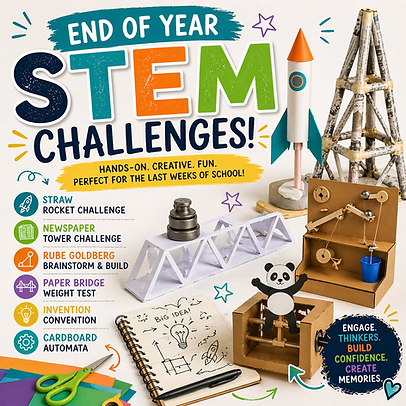
You've made it to the final stretch. The energy in your building has shifted — students can feel summer coming, and if we're being honest, so can you. The last thing you need right now is a complicated unit to plan and execute.
What you need are activities that are genuinely engaging, require almost no prep, and still feel meaningful. Activities where students are doing the thinking, building, and problem-solving — and you get to watch it happen.
These six end-of-year STEM projects are exactly that. Low prep, high engagement, and worth every minute of the time you have left.
🚀 Build Your Makerspace Toolkit Before the School Year Begins
Imagine heading into next fall already prepared — with a full toolkit of ready-to-use makerspace projects in hand before the school year even starts.
The Maryville STEM Certificate Program is a two-week, hands-on summer experience where you’ll build practical skills in makerspace design, novel engineering, robotics, coding, and more — and leave with lessons you can immediately bring into your classroom on day one.
No scrambling. No last-minute searching. Just confident, creative teaching.
Over two immersive weeks, you will:
Explore makerspace design
Dive into novel engineering
Work with robotics
Learn coding fundamentals
And more!
You’ll also collaborate with a community of educators who are learning, experimenting, and building alongside you.
📅 Program Details:
Dates: June 1–12, 2026
Schedule: Monday–Friday, 8:30 a.m.–4:00 p.m.
Location: Maryville University Campus
💰 Cost & Credit Options
Program Fee: $990
Optional Graduate Credits: 6 credits available for an additional $720
Payment plans available
📧 Questions?
Email: groberts1@maryville.edu
Table of Contents
1. The Straw Rocket Challenge
Objective: Students will design, build, test, and improve a straw rocket while exploring force, motion, aerodynamics, and the engineering design process through rapid iteration.
Resources Needed:
Straws
Index cards
Tape
Scissors
Optional: measuring tape or floor markers for tracking distance
Example Challenges / Questions:
What part of your design had the biggest impact on how it performed?
If you could only change one thing, what would you improve and why?
What patterns do you notice in the rockets that worked well?
Try this: Add a target on the floor and challenge students to design for accuracy, not just distance.
2. Newspaper Tower Challenge
Objective: Students will build the tallest freestanding structure using a single sheet of newspaper and tape that can support a textbook on top for ten seconds.
Resources Needed:
1 sheet of newspaper per team
2 feet of tape
1 textbook (for testing stability)
Example Challenges / Questions:
What design choices helped your tower be successful?
How did your team decide between making it taller or making it stronger?
3. Rube Goldberg Brainstorm and Build
Objective: Students will design and build a Rube Goldberg-style chain reaction using classroom materials to complete a simple, specific final action.
Resources Needed:
Short video example of a Rube Goldberg machine
Classroom materials (books, pencils, rulers, paper, etc.)
Example Challenges / Questions:
What would you do differently if you built it again?
How did gravity affect your machine?
What types of motion are you using? (rolling, falling, sliding, etc.)

4. Paper Bridge Weight Test
Objective: Students will design and build a paper bridge that spans a 6-inch gap and can support the greatest possible weight using limited materials.
Resources Needed:
5 sheets of paper per team
12 inches of tape per team
Two desks (or supports) set 6 inches apart
Weights for testing (pennies, textbooks, or other classroom materials)
Example Challenges / Questions:
What design choices made your bridge stronger or weaker?
What changes would you make if you had a second attempt?
How did distributing weight affect the stability of your bridge?
5. Invention Convention
Objective: Students will identify a real-world problem in their school, home, or community and design an invention that could help solve it.
Resources Needed:
Paper for sketching/designing
Pencils, markers, or colored pencils
Example Challenges / Questions:
What problem are you trying to solve, and why does it matter?
What makes your invention unique compared to existing solutions?
How would you explain your idea in a 60-second pitch?
6. Cardboard Automata
Objective: Students will design and build a cardboard automata that uses a simple mechanical system (crank or lever) to create visible motion in a moving figure.
Resources Needed:
Cardboard (base and structure materials)
Pencil or wooden dowel (for crank mechanism)
Straws or small sticks (for guides/axles, if available)
Tape and/or glue
Scissors
Markers, colored pencils, or craft materials for decoration
Example Challenges / Questions:
What type of movement does your automata produce (flap, spin, lift, slide)?
What story or idea does your automata represent?
How would you improve your mechanism if you rebuilt it?
The end of the year doesn't have to mean survival mode. With the right projects, these last weeks can be some of the most memorable teaching you do all year — for your students and for you.
Ready to walk into next fall with a full library of projects like these already in hand? The Maryville STEM Certificate Program this summer is your shortcut to a whole new year of confident, creative STEM teaching. Learn more and register →


Comments